
About Us
Curious what recycling with Earthworm actually looks like? Check out our short video to find out who we are and what we do!
Mission
Earthworm's mission is to promote recycling in the workplace. We accomplish this by providing a collection service that is easy for first time recyclers to implement. Also, by reducing barriers to recycling through friendly assistance, flexible programs and affordability, Earthworm enables small businesses and others who are underserved by the private sector to establish office recycling programs.
Earthworm also recognizes that there are many other local groups who are working toward similar goals of conserving natural resources. Earthworm further promotes recycling through collaboration, mentoring and direct support to these groups.
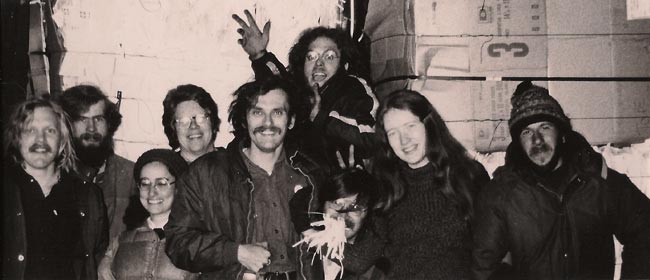
Earthworm staff c1974
History
Earthworm was founded on Earth Day in 1970 by three MIT computer science students. Originally named the Recycling Revolutionary Coop, the goals of this early venture were to demonstrate the viability of recycling by operating a self sufficient enterprise, to save natural resources, and to create a non-hierarchical workplace. The organization began by using an old beer truck to collect key punch cards, computer paper and other waste paper from commercial, government and nonprofit offices in the greater Boston area.
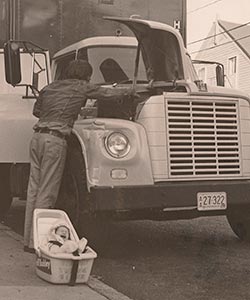
In 1974, the coop changed its name and Earthworm, Inc. won out over other choices such as the Green Gurus and Transcendental Recycling. At the same time, the organization formally recognized the overwhelming need for public education on the value of recycling and earned nonprofit status as a 501(c)3 educational organization.
In the late 1970's and early 1980's, Earthworm evolved into a women-only collective that, in addition to working on recycling issues, put emphasis on placing women in non-traditional roles (truck drivers). The organization reverted to co-ed status in 1982.
In 1987, Earthworm responded to the growing need for technical assistance to public recycling projects by providing consulting services to groups such as Massport, the City of Boston, the City of New York, the Boston Chamber of Commerce, The University of Massachusetts and the State of Rhode Island.
In 1990, Earthworm introduced its "Close the Loop" program for selling recycled office products as a means of providing free pick ups to cost conscious clients. This program was also aimed at helping to stimulate the demand for markets for recyclables.
In 1996, Earthworm joined forces with other recycling organizations in the state under the banner of MassRecycle to offer educational programs to public schools. With a goal of boosting residential recycling rates, the REAPS Project (Recycling, Education and Assistance in Public Schools) provided classroom activities on recycling, composting and hazardous waste plus, helped to establish collection programs in school buildings.
Earthworm began collecting glass, plastic and metal containers (mostly bottles and cans) from businesses in 2007. This program came about as a response to the explosion of "take away" food and beverage containers now found in lunchrooms and office kitchens. This program is a companion to our longstanding office paper recycling program.
Following growing concern about the inappropriate disposal of computer monitors, Earthworm began collecting and recycling monitors and other scrap electronic equipment in 2000. Earthworm now accepts most forms of e-scrap and either finds reuse applications for the hardware or gets the materials recycled.
In 2009, the organization formally began to collaborate with other local, nonprofit organizations that seek to save natural resources through reuse. For more information on this network of nonprofits, visit our Reuse section.
There have been common threads that wind from 1970 to the present. They are: self sufficiency in the form of reliance upon the revenue from our trucking operation, the collection and recycling of office paper, and maintaining a cooperative management style.
Confidentiality
Recycling is an important activity, but we understand that confidentiality is a paramount issue. As a result, Earthworm goes to great lengths to ensure that any information we collect, in either paper or digital format, is carefully shepherded throughout the recycling process. Earthworm has been collecting scrap materials from offices since the 70's without a single breach of customer confidentiality.
Handling practices - paper
All of the paper that Earthworm collects is completely transformed by industrial recycling processes. No printed information survives this transformation. Our procedures satisfy the concerns expressed in both federal HIPAA and state CMR 17.00 regulations and the following describes our collection procedure as well as the path your paper will take.
Your paper is loaded by our staff into wheeled hampers. These hampers are then loaded onto our enclosed, box truck. Often, the paper from several companies is mixed together in these hampers. At the end of the day, our trucks unload at a local, secured and enclosed recycling facility. Each of the hampers is weighed prior to having its contents dumped onto a conveyor belt along with literally tons of other waste paper. The paper is conveyed past a sorting line of 6 to 10 workers who search for contaminants and then is fed into a hopper that chops the paper into pieces. This chopping process will render an 8.5 x 11 sheet of paper into about 4 or 5 pieces. The chopped paper is then baled into 2000 lb. cubes (like hay bales) for efficient shipment to paper mills. Baled waste paper is often stacked and then stored before being shipped. This period of storage may be as little as one day, or as much as two weeks. Bales are shipped via tractor trailer, rail and shipping containers to paper mills throughout North America. Upon arrival at the mills, the baled paper is dumped into a hydro-pulper (like a giant blender) and mixed with water and de-inking agents. With the ink removed, the paper is churned into an "oatmeal like" slurry before being made into new paper products. It is at this point that any paper we collected is transformed and any printed information is destroyed.
The likelihood of anyone gaining access to printed information at any point in the collection/sorting/baling/shipping/re-pulping process is not impossible, but it would be extremely difficult and therefore extremely unlikely. For this reason we are confident that our recycling process is vastly more secure than the typical trash disposal process and it is destructive enough to meet most sensitive document handling needs.
Handling practices - electronics
Earthworm routinely collects and recycles all manner of electronic office equipment, including computers. As an advocate for the wise use of natural resources, we value re-use above recycling. It is therefore possible that any electronic waste we collect may eventually be re-used. With regard to information bearing equipment such as hard drives; although we carefully select our end-use vendors, we strongly encourage clients to wipe or remove any information prior to our arrival. We will, upon request, remove and destroy hard drives. Please click here for more information on this certified destruction service.
Disclaimer
Earthworm takes considerable care in its handling of paper and computer scrap. However, we cannot absolutely guarantee that client information could not be reconstituted, through near impossible measures, downstream from our custody and control. Earthworm disclaims responsibility for, and hereby waives and releases Earthworm and its agents from liability for any loss, claim or damage whatsoever arising out of or relating to information that is reconstituted downstream. Under no circumstance will Earthworm have any obligation or liability for any direct, incidental or consequential damages, regardless of how such damages arise and of whether or not a party was advised such damages might arise.
Staff Bios
Earthworm was founded as a collective. All staff shared the physical work of trucking and made decisions as a group. The organizational structure has changed a bit over the 40 plus years of Earthworm's existence, yet some core features of this non-hierarchical style continue. The organization does have an Executive Director - Jeff Coyne, and each staff person tends to have an area of focus. However, all staff - including the Director, participate in a wide array of work - from answering phones to driving the truck.

Jeff Coyne
Jeff came to Earthworm in 1983 after a few years of post-college explorations. He was drawn by Earthworm's co-operative, hands-on approach to solving environmental problems and he has never lost that initial attraction. Along the way he has discovered a natural ability for creating efficient trucking routes (which he owes to his degree in Geography from Rutgers University), accumulating pencils and balancing the needs of the organization with the needs of the staff.
When not on the clock, Jeff might be gardening, making music compilations, reading nonfiction, looking for rocks to make stone walls, or becoming un-stuck in time while researching family or local history.
In September 2021, Jeff was awarded the MassRecycle “Lifetime Commitment Award” for his outstanding work in recycling, reuse and waste reduction.

Georganna Woods
Georganna answered an ad in 1990 for “an environmentalist truck driver” and has been with Earthworm since. For the majority of her tenure, she was one of our regular drivers. Nowadays she divides her workweek between Earthworm and Philanthropy Massachusetts. At Earthworm, she now assists with bookkeeping and office support.

Libby Hanna
Libby is manager of Simple Office Services, LLC and provides bookkeeping services to Earthworm, other nonprofits, and small companies in the Boston area. She has a BA in Psychology from the University of Rochester and a Certificate in Computerized Accounting from Middlesex Community College.
When she’s not debiting or crediting, she pursues her hobby of raising and showing gerbils through her kennel Shawsheen River Gerbils and the American Gerbil Society.

Paul Hanley
Paul joined Earthworm during the summer of 2015, bringing with him 18 years of truck driving experience. If you couldn’t tell from his accent, Paul hails from Dublin, Ireland. He loves football (a.k.a. soccer), big cats and U2. He is also equipped with an endless supply of hilarious jokes.

Jack Hawkins
Jack joined earthworm in the early spring of 2016. Drawn by the “Environmentalist Truck Driver” job description, he brings 8 years of driving experience and will be helping out both on the truck and in the office and warehouse. While earning his degree in Social Thought and Political Economy at Umass Amherst Jack honed his skills as a bus driver for the university. After leaving Umass, he worked for four years at Enterprise Farm in Whately MA.
Jack is also an avid gardener, guitar player, reader of scifi/fantasy/historical fiction, and aspiring captain of his own sailing canoe.

Laura Olivier
Laura joined Earthworm in February 2018, and assists on the trucks and also provides customer outreach and education. A graduate of Washington University in St. Louis with a degree in Environmental Studies, Laura first became passionate about different waste streams and how they’re managed while studying abroad in India in 2011. She most recently worked as an environmental science educator in Lawrence, MA for four years.
Laura also feeds her waste reduction interest by volunteering for food rescue organizations, but aside from the waste world enjoys singing, practicing Spanish and Hindi, and staying active through soccer/dance/kickboxing.

Deoliveira Barbosa
Barbosa started at Earthworm in the summer of 2019. He has over 10 years of truck driving experience, garnered by delivering cabinets and working for a moving company. Aside from driving, he will also provide maintenance on the trucks and equipment, and handle most of the hard drive destruction at Earthworm.
Barbosa grew up in Brazil, but also speaks Italian and Spanish in addition to his native Portuguese. Outside of work, he is highly involved in his church and mentors youth in his community. He loves to follow soccer and go hiking in addition to spending time with his wife and three kids.

Caroline Meadow
Caroline is a partner in Simple Office Services, LLC, and works as part of the bookkeeping team at Earthworm. As the daughter of Libby Hanna (current fellow bookkeeper) and granddaughter of Penny Yunuba (truck driver in the 1970s,) she became a third-generation Worm upon joining Earthworm in 2020.
She works remotely in the company of her dog, Theo, who is also an avid recycler and joins the fight against improper waste disposal by collecting pieces of litter he finds on walks and trading them in for treats.

Allie Dick
Allie was hired at Earthworm as a truck assistant in October of 2022. She was interested and inspired by Earthworm's mission to promote recycling in the workplace and could not pass up the opportunity to be a professional passenger (guaranteed shotgun!). Prior to working for Earthworm, Allie had administrative roles in affordable housing, software, and architecture. Before that, she worked for Starbucks where she slung lattes and managed multiple stores for over a decade.
Allie is interested in the zero-waste movement and encourages those reading to check out Cleenland in Cambridge. She loves the beach, live music and comedy, roller skating, crafting, karaoke-ing, and watching way too much TV.